
IN THIS ARTICLE
Finding the Qibla in a new hotel, airport or unfamiliar city can feel difficult when you do not know the surroundings. A location-based bearing gives you a starting direction, but the result is only as useful as the location and compass reading behind it.
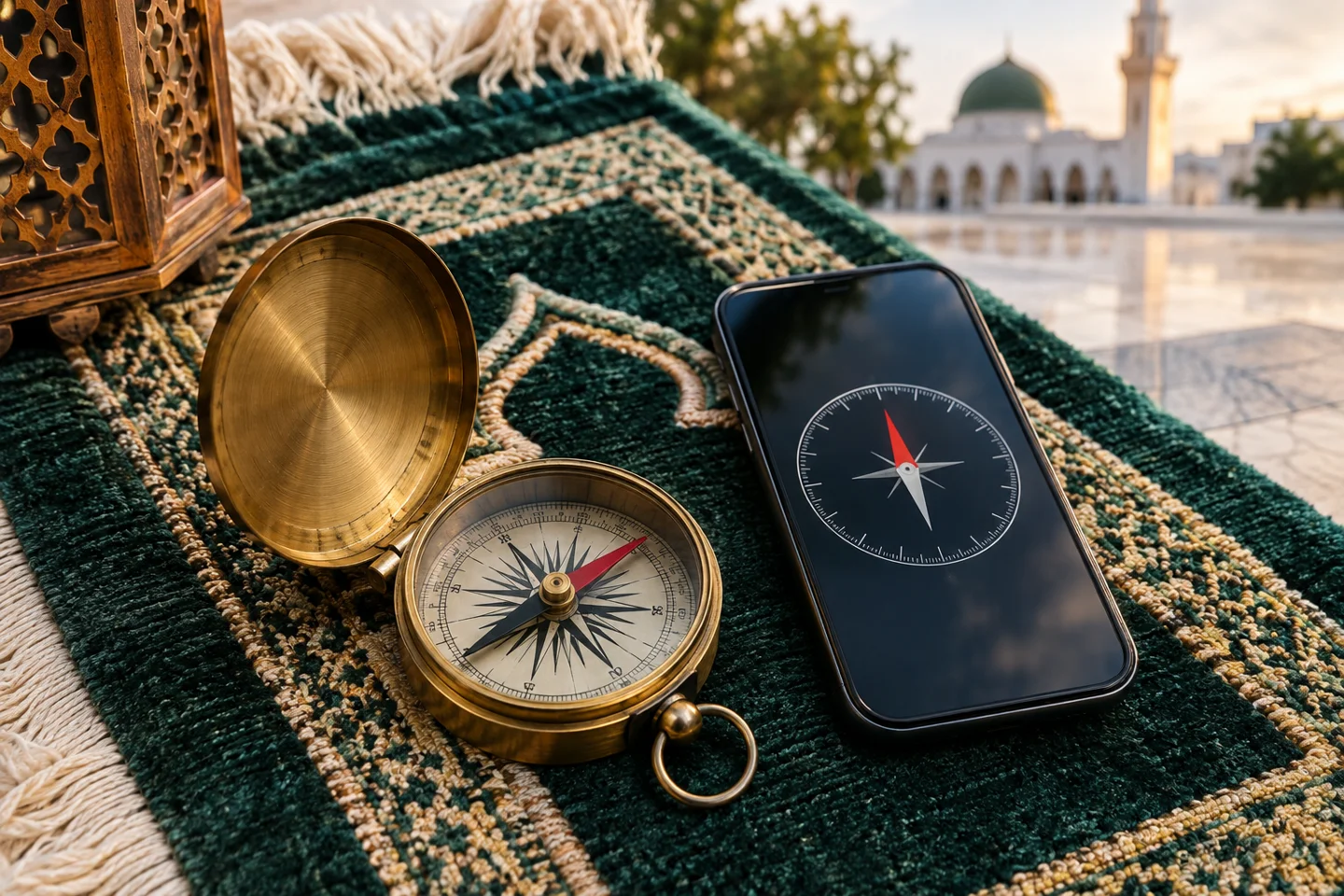
A Qibla finder calculates the initial direction from a selected location toward the Kaaba in Makkah. The result is normally shown as a bearing in degrees clockwise from true north. A map view or compass can help you orient yourself, but indoor magnetic interference and a phone’s sensor calibration can affect the direction displayed by a device.
Use the right location
Choose the city you are actually in or enter the coordinates of your current building. City-centre coordinates are useful for a general estimate, but may be several kilometres from your hotel or prayer space. If you choose browser location, your browser asks for permission; manual coordinates are an alternative.
True north and magnetic compass readings
A calculated Qibla bearing is commonly measured from true north. A phone’s magnetic compass senses the local magnetic field, which can be disturbed by metal structures, speakers, vehicles, electrical equipment or a magnetic phone case. Some devices apply a magnetic declination correction; others may show a raw sensor direction. Treat a sensor reading as a guide, especially indoors.
Simple checks when a compass seems off
- Move away from large metal objects and powered equipment.
- Follow the device’s calibration prompt if one appears.
- Check that the selected location and hemisphere are correct.
- Compare the bearing with a map view or another reliable source.
- Ask mosque staff or a trusted local Muslim if you remain unsure.
Our Qibla Finder calculates a bearing and distance from your selected location. The optional device compass is a convenience feature; it cannot guarantee precision in every environment. For related location-based worship tools, see Prayer Times.
What the number does—and does not—mean
The degree value describes a direction along the Earth’s surface from the selected point. It is not a route instruction for walking or driving, and it does not mean a phone sensor is perfectly aligned. Use the tool to orient yourself, then apply the guidance and practice you follow.
This article explains direction-finding technology and does not provide a religious ruling.

ABOUT THE AUTHOR
Miss Ayesha · Marketing Manager, Al Marifah Travels
Marketing Manager at Al Marifah Travels.
Sources and further reading
This article is general travel-planning information, not a visa decision, religious ruling or booking confirmation. Verify current requirements for your own circumstances.
Planning a journey? Share your departure city, dates and travel preferences to start an enquiry.
Plan your Umrah